Showing posts with label interfaith. Show all posts

Sunday, November 23, 2008

Can we talk?

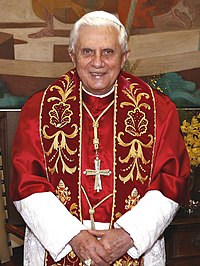
Pope Benedict may have gotten himself in trouble, again. Or at least that's what would seem to be implied by an article -- headlined "Pope Questions Interfaith Dialogue" -- from the New York Times' new Rome correspondent, who quotes the following from a letter the Pope wrote to an Italian politician:

“an interreligious dialogue in the strict sense of the word is not possible.” In theological terms, added the pope, “a true dialogue is not possible without putting one’s faith in parentheses.

My guess is that -- while I doubt that the Pope is being misquoted here -- he is, as it was in the controversy about his 2006 Regensburg lecture, being a bit misunderstood. This Pope has not yet learned (and maybe he never will) that for someone in his station it is impossible to try and make subtle statements about something as sensitive as whether Catholicism sees other religions as legitimate or not. My guess is he was trying to make a statement about exactly what is possible in inter-religious dialogue, not whether inter-religious dialogue is a good thing or not (which, based on his meeting with Muslim leaders earlier this month, for example, he seems to be in favor of).

As a Jewish clergyperson whose primary occupation at moment is training Christian ministers in pastoral and spiritual care these kinds of issues are anything but theoretical. I work with students who may believe that true healing can only come through Jesus, a belief I certainly don't share. Can I come to care about the learning and growth of a student who believes this way, and even help them to apply it? The answer has to be, yes, or else I would have to quit my job. But that doesn't mean it is easy for me. I am helped by the thought that I care about the well-being of all members of humankind, Jew and non-Jews, and want them all to know what it is like to be treated as if they are made בצלם אלוהים/btzelem elohim -- in the image of God -- especially when they are sick or helpless. But, as I said above, it is not always easy.

There is no doubt that the fate and health of the Jewish people -- the people who brought the concept of בצלם/btzelem to all the world -- has a special and dear place in my heart. I became a rabbi most of all to be in service to that people and to be a force working for their health and survival and for the health and survival of their Holy tradition -- of Torah.

As I stated above, my current professional life is primarily among non-Jews. I know that I still believe I am serving the Jewish people in that work, if indirectly. But I also know that I feel a hunger for a more direct involvement and that I will be searching for ways to bring that into my life in the coming years and months. That is in large part why it was such a gift to me this year to be able to spend two months in Israel. I am deeply grateful for that.

Wednesday, May 07, 2008

The wounds of our Sages -- the truths that bind us across faiths

One of the most striking texts I know in rabbinic literature is one where the Rabbis of some two thousand years ago ask an audacious question -- perhaps it would have been better for humans never to have been created in the first place?

When I first read it, this text really disturbed me. How could people of faith -- especially in a faith tradition that reveres life so much -- possibly even ask such a question? Hadn't God declared the life God created to be "good" at the beginning of the book of Genesis? Would it not be blasphemy to reject God's good creation?

In the years since, I have come to see this text differently, and, in fact, it has come to have deep personal and spiritual meaning for me.

Nonetheless, it was with much trepidation that I brought this text on Monday before a group of Christian and Jewish clergy who had come together for an interfaith dialog in New York. The topic of the moment was "Problem Texts", texts from our Holy literatures -- and there are many -- that can seem troublesome because they might appear to advocate hate or intolerance or have other problems. I was anxious about bringing it because, in it, the Rabbis do not just ask the question. They answer it. They say it would have been best for humankind not to have been created.

And so it was with much joy that I heard my colleagues responding with reactions similar to mine when I presented this text at the "Colleagues in Dialogue" meeting of the Center for Christian-Jewish Understanding. One woman -- a cantor who is the spiritual leader of a Reform congregation in New Jersey -- said this text made the ancient Rabbis seem more human and more accessible to her. Another person saw in it a troubling existential question that bothers many -- why did God not create me perfect?

There are so many deep meanings for me in this text. I don't think the Rabbis were literally saying it would be better if God had never created us. Rather, I think they're acknowledging a painful and universal truth -- life, as beautiful and wondrous as it is, is full of suffering. You can see it in almost every room of the hospital. And so much of it is inexplicable. It's a mystery. Why would God create a world where a 40-year old woman gets cancer and leaves her children without a mother? Why would God create a world where even children can get cancer and suffer unspeakable pain and even die? What sort of loving God would do that?

And, in the face of so much inexplicable suffering -- whether it be our own, or that of others -- sometimes the person who has any kind of compassion or empathy in his or her heart is just going to want to give up. Just throw in the towel. Even -- if just for a fleeting moment -- wish one had never been born.

It's a comfort to me to know that I am not alone in having these kinds of thoughts and feelings -- that even the wisest ones of my Sages experienced them as well. It makes me feel less alone in my darker moments, moments that are unavoidable if I am to open my heart up to others who are in pain and be a chaplain and spiritual caregiver to them.

But the real comfort in this text comes at its end -- for the Rabbis do not just conclude with their decision that it would have been better for humankind never to have been created. Instead, they go one step further -- they say, well, now that we have been created, the thing to do is for us to focus on our deeds, to focus on doing the right thing before God.

This is the great message of Judaism for me -- do not give up, even in the face of the greatest challenges and the greatest wounds and brokenness you can imagine. Hang on to life with every fiber of your soul and try and make it a good life. A good life -- the kind of life that God would find good. The kind of life that follows God's way. The kind of life that is as full of acts of loving kindness as you can make it. There lies the "redemptive turn" for me.


Here is the full text of the source as I presented (and translated) it (I also gave it the provocative title "The Suicide of the Rabbis?"):

The suicide of the Rabbis?

Talmud Bavli, Eiruvin 13b

Our Rabbis taught: For two and a half years Beit Shammai and Beit Hillel debated. ת"ר שתי שנים ומחצה נחלקו ב"ש וב"ה
One of them said it would be better for humankind to never have been created. הללו אומרים נוח לו לאדם שלא נברא יותר משנברא
And the other said it was better for humankind to have been created. והללו אומרים נוח לו לאדם שנברא יותר משלא נברא
At the end, they voted and decided that it would have been better for humankind to never have been created. נמנו וגמרו נוח לו לאדם שלא נברא יותר משנברא
But now that humankind has been created, a person should examine his deeds עכשיו שנברא יפשפש במעשיו
And others say a person should examine his future deeds. ואמרי לה ימשמש במעשיו

After reading the text to the group, I asked them to ponder a couple of questions with a partner for five minutes before we discussed it as a group:
  • What is your initial reaction to this text? Does it bring any image to mind?
  • What does the story mean? What are the rabbis in truth trying to say here?


Redemption comes in many forms. Above, I said that, for me, this text inspires me to make the redemptive move from despair at suffering to focusing on my deeds that have the potential to do something about that suffering and bring healing to others.

The search for some kind of redemption through deeds is very much the stuff of what much of the interfaith conference was about. Some of my Christian colleagues made some striking Problem Texts presentations where they strove to courageously face up to how some of the texts of their traditions have been used in the name of violence and intolerance, and to seek solutions that involve anything but throwing those texts out. Two Catholic priests wrestled with a passage from Mathew (26:14-27:66) that has been used to blame the Jews collectively for the death of Jesus Christ, while a protestant pastor took on a passage from John (14:1-14) that some Christians use as proof that Christianity is the only path to truth.

I was inspired by their efforts, especially because both of their efforts very much involved preserving the sacredness and meaning of these texts to them. This is what I also seek to do with the troubling texts of my own tradition -- search for honest ways of understanding them that allow me to keep them close to my heart and my soul.

May it be the will of the Holy Blessed One that all your troubles and sorrows be transformed into sources of meaning and joy.

Wednesday, November 21, 2007

Is it the miracles (a Thanksgiving question)?

I have to admit I have never given much thought to the meaning of Thanksgiving. I have thought of it primarily as an opportunity for folks to get together with their families, which is something that can be the source of all kinds of meaningful stuff. But does the holiday itself have some kind of meaning? Is that meaning rooted in the story that's told about the holiday, like the way the meaning of Passover is deeply rooted in the story of the Israelites' redemption from bondage in Egypt?

The below prayer from Rav Zalman would seem to suggest that the meaning of Thanksgiving is indeed rooted in that traditional story. The prayer is written to be included in the "about the miracles" section of traditional Birkat HaMazon, or 'blessing of the food' that is said after meals. The insertion into the "about the miracles" section (which is where we traditionally make insertions on Hanukah and Purim) in and of itself suggests that what we are thankful for on Thanksgiving has something do to with miracles given to us by the Divine. And the content of the insertion suggests the miracle has something to do with the traditional story about Thanksgiving I was told as a kid where poor settlers were helped by Native Americans.

I wonder, however, do we still tell our kids that story? Is there something in there that might be offensive to Native Americans? Do we really want to uphold that traditional story when we celebrate Thanksgiving, or is it about something else for us now? I'm not sure I'm comfortable with this blessing.

But this year, I'm just glad that tomorrow I will have the opportunity -- God willing -- to see my Mom and my Sister and her kids. I hope you will have the opportunity to be with people you care about, too.

Happy Thanksgiving!

______________

Rav Zalman's "About the Miracles" blessing for Thanksgiving

(click on image to see full size)

Sunday, October 28, 2007

Finding fellowship (the Jews of Dallas, the Jews of CPE)

One of the great highlights of a wonderful few days I have had in Dallas during the Association of Clinical Pastoral Education's annual conference was a meeting of a group of Jewish supervisors and supervisors-in-training organized by the extraordinary Rabbi Naomi Kalish.

This meeting was so important in part because of the content of what we talked about -- especially the project of how Jews, and Jewish concerns, can get more of a "seat at the table" at the APCE. But, it was also so important to me just for the fellowship of it.

It can really be lonely being a Jew in CPE. When I was a rabbinical student considering doing CPE I had trouble finding anyone to talk to who had done CPE before; and, certainly, none of my professors or deans had. What a contrast to the mainline Protestant world where CPE has been required of most seminary students for decades. Seminary students have tons of people -- both peers and professors -- who can talk to them about their own CPE experience. And the Protestant people who go on to train to become a CPE supervisor will find that almost all of their peers come out of their same general faith tradition (Protestantism).

Not so for a Jew like me. And so I just want to express how deeply grateful I am to Rabbi Kalish for her efforts to form an official Jewish Network in the ACPE and for making our meeting in Dallas happen. I feel like I have חברה/hevre (community/colleagues) now! I can't even begin to tell you how that makes me feel!

______________________

In Judaism we consider הכנסת אורחים/hachnasat orahim (the welcoming of guest) to be one of those great mitzvot that merit a reward both in this world and in the World to Come. I was so welcomed by the Jewish community here in Dallas. Not only by my host Rabbi Paul Steinberg and his family, but also by the members of Congregation Shearith Israel, and, especially, the rabbi of their minyan that I attended on Shabbat, David Glickman.

I most certainly felt like I had fellowship with the Jews who I met here in Dallas, and I am very grateful for that. I will be thinking of them long after I return home to Pennsylvania tonight. Thank you!

Friday, October 26, 2007

They just don't get it (being a Jew in CPE)

The Jews have had the observance of Shabbat for well over two-thousand years now, but amazingly, the Association of Clinical Pastoral Education (which, ironically, is dedicating its annual conference to multiculturalism and diversity), seems seems not to have figured this out, yet.
Tonight -- when observant Jews around the world will be dispensing with operating electrical devices and the consumption of popular media and entertainment as part of their core religious observance of Shabbat -- the association has chosen to schedule the event of most interest to Jews -- the showing of a bit of popular media about Jews.
It's a documentary film called Trembling Before God. The film is an intense examination of the struggle some observant Jews have faced with reconciling their core religious beliefs and practices with their realization that their sexual orientation is gay.
I know exactly what will happen tonight. The overwhelming Christian members of the association will be deeply touched by the film. But they'll also be confused. They won't understand some of the practices the people in the film were struggling with. They'll want to ask the Jews questions. And so they'll look around them. But the Jews won't be there (I, for example, will be celebrating Shabbat with a dear friend in North Dallas, dozens of miles away -- much too far for me to walk, even if I was willing to watch a film on Shabbat).
I wouldn't care so much if this was an isolated incident. But it's not. Next year, the association's annual conference, dubbed "Courageous Conversations: Division, Diversity and Dialogue," will probably be lacking any Jewish participants in that dialogue -- most of us will be elsewhere celebrating the holiday of Simhat Torah which falls on the first day of the conference. Even if I could get on a plane right after the holiday, I would still miss most of the conference.
And then there was the memorial service at the conference, yesterday. There are few things that feel more like a fundamentally Christian form to me than a choir. Now, admittedly, some Jews are ok with choirs, but why would experts in interfaith dialogue and learning -- like the CPE supervisors at this conference -- chose a form that is so potentially problematic? And not just for Jews. I have only been in a mosque a few times, but I can tell you that there was nothing that looked like a choir (or an organ or anything like that) in those mosques. Might a Muslim also find a choir a strange form that somehow feels Christian?
Now I want to add that I was deeply moved by parts of the memorial service (especially when Bob Cholke's name appeared on the screen). And also that I have found this conference incredibly valuable to me and that I am a big believer in CPE in general, in the ACPE in particular and in the incredibly wonderful work CPE does every day to help future clergy and other students become more sensitive to differences in people's beliefs and practices. The ACPE is most certainly an organization that is devoted to interfaith ministry in a profound way.
One of the senior supervisors at the conference listened to my story of how alienated and excluded I felt by the choir being in the memorial service and he challenged me to give him a picture of what would be more acceptable. I will respond to that challenge soon in a comprehensive way. But I want to just say a few quick things, first.
A part of the service that did work really well for me was the reading of a powerful poem by Maya Angelou called Elegy. Here are some of its lines:
I lie down in my grave
And watch my children
grow
Proud blooms
above the weeds of death.
. . . the worms, my friends,
yet tunnel holes
bones and through those
apertures I see rain.
Why was this more acceptable? One reason is something that comes out of 'CPE 101' -- the importance of using "I" language when you are dialoging with someone about intense feelings or experiences. The voice in the poem speaks of something "I" experienced. There is no use of the word "you" and all the use of that word might demand of the listener to do or feels something the speaker wants. That is, the poem did not demand that I share any belief or practice of the speaker.
So, I remain hopeful that there will be more sensitivity to the presence of non-Christians in chaplaincy. But there is much work that needs to be done.

Sunday, August 26, 2007

The darker side of Facebook

I've only recently joined Facebook, the wildly popular social networking site that started out just being for college students. It's mostly just been a fun way to reconnect with some old rabbinical school classmates and other friends.

But apparently people use it for other reasons, including the spread of hate. Today, a friend asked me to sign a petition demanding Facebook shut down the "F**k Islam" group on the site (and, no, the real group name does not include the asterisks).

I am just appalled that anyone would form such a group and give it such a name. Sure, you can hold opinions criticizing a faith tradition. You can even talk about those opinions on a place like Facebook -- that's what we call free speech. But, if we really do all want to "get along", we have to express our opinions in ways that are respectful, especially when we are dealing with things that others consider most Holy. This goes way too far. It's disgusting and it has to stop.

I really hope this sort of thing is not what Facebook is really all about -- because if it is I'm most definitely not staying around.

Monday, July 23, 2007

Holy books banned by the Feds?

It sounds like there's some exaggeration in this article. But, nonetheless, as a person of faith I am concerned -- I can't imagine any legitimate reason for the federal prison authorities to be limiting the Holy books of any faith tradition.
clipped from The Jewish Week
(07/20/2007)

Fearing Muslim ‘radicalization’ in prisons,
feds limit number of religious books.
Jewish Inmates Say Torah Now Banned
Fearful that some religious books —
particularly those of Muslims — might promote “violence and
radicalization,” the federal Bureau of Prisons has removed all
but 150 books per religion from its prison chapels. As a
result, Jewish inmates who have long had access to hundreds of
Jewish books, complain that now even the Torah is denied to
them.

blog it
_______________________________
UPDATE (7/25):

Apparently, as I predicted, there was some exageration in the article. Or at least that's what it seems from this letter the New York Board of Rabbis wrote to the editor of Jewish Week:

July, 24, 2007
The Jewish Week
1501 Broadway, Suite 505
New York, NY 10036
Attn: Gary Rosenblatt, Editor
Stewart Ain, Staff Writer
Dear Editor:
With regard to your recent article entitled “Jewish Inmates Say Torah Now Banned,” (07/20/07). The New York Board of Rabbis understands that the removal of Jewish books is part of a comprehensive review process of all religious materials of all faith constituencies, according to the Chief Chaplaincy Administrator of the Federal Bureau of Prisons. Upon completion of this process, all such materials will be returned to the prison library. Furthermore, no limitation will be placed on the number of books available to inmates. The following two communications were received from Rev. Susan Van Baalen:

Dear Rabbi Potasnik, This is a follow up to our recent conversation regarding procedural and operational changes for chapel libraries Bureau-wide. Approximately one year ago we began a process of reviewing all library holdings with a view to discarding all materials that were discriminatory, or had the potential to incite violence or foster radicalization of inmates. In order to ensure that all libraries had some materials available, during the lengthy review process, we asked Subject Matter Experts (in the Jewish case, two Orthodox and one Conservative rabbi) to provide us with an initial list of up to 150 books, and 150 audio and video selections that were unquestionably suitable for prison libraries. After the publication of the initial list, we announce that additional items would be added to the lists after the SMEs had the opportunity to review additional materials. At no time was there a decision to limit the holdings to 150 per faith group.

* * * * * * * * * * * * * * * * * * *

We have informed all stakeholders and the media of the process, but it seems they prefer to print their own interpretation of the process. Both stakeholders and chaplains have been informed that the list of library holdings will be updated in October. Chaplains and stakeholders were asked to submit titles, authors, publishers and ISBN numbers of books and other materials they wished to have reviewed. To date we have received very few. As the materials are submitted to us, they are forwarded to the subject matter experts for review and likely inclusion in the October update, or a future update, if not received in sufficient time to review for October. Books will not be removed from the shelves; instead, additional books will be added to the original 150.
It is not true that the Torah is denied them – although Sefar Torahs are not items we can afford to purchase and protect in the prisons. In the few institutions where Sefar Torahs are accessible, there is still access. Sidurs and Tenach are available in every prison.
The Torah and Tenach are not considered library holdings. These are worship materials and stored and used as such. They do not circulate as library books.
With regard to the mistakes in the Jewish Week article – it is fraught with error. The number of Jews is approximately one-half the number cited by Aleph.
The library renewal project has not been delayed. There are benchmarks that have been met, and future benchmarks that will be met. This includes continued review of materials and continued updating of lists. Most importantly, to be sure you understand, I repeat what I have told all of our stockholders and those inmates who have inquired: This is an on-going process. The lists will be updated at least annually, adding books to the initial collection of approximately 150. Prayer and worship aids are not considered library materials – and no action has been taken with respect to worship aids. Thank you for your cooperation.

Please note that the NYBR is the endorsing and reviewing body of all Jewish chaplains in our City and State Correctional facilities. We also maintain communications with Federal officials and will monitor this latest development. Each Jewish inmate is entitled to access all religious materials in every institution, and we at the NYBR are determined to protect that right.
The NYBR is the largest interdenominational rabbinic body in the world representing all denominations within the Jewish community

Rabbi Joseph Potasnik
Executive Vice President
New York Board of Rabbis

Rabbi Stephen Roberts
Associate Executive Vice President &
Director of Jack Weiler Chaplaincy Program
New York Board of Rabbis

Rabbi Arthur Morgenstern
NYBR Liaison to Correctional Facilities

A Modern Orthodox rabbi takes on interfaith prayer

An interesting post (with comments) from a Modern Orthodox rabbi with an ill congregant who has some born-again Christian friends who want to pray for her:

Personally, I am not terribly bothered by their request. If we follow the Rama's ruling that Christianity is not classified as avodah zarah for non-Jews, why not permit them to do what they want?

Other WACvillians have a different take; they view these “friends” as preying rather than praying, attempting to convert her.

The full post.

Thursday, July 19, 2007

Secular Turks may vote for religious parties

From the New York Times:

Election in Turkey May Be a Watershed

ISTANBUL, July 17 — For 84 years, modern Turkey has been defined by a holy trinity — the army, the republic and its founder, Mustafa Kemal Ataturk. Each was linked inextricably to the others and all were beyond reproach.

But a deep transformation is under way in this nation of 73 million and elections this Sunday may prove a watershed: liberal Turks, once the principal political supporters of the nation’s ruling secular elite, are turning their backs on it and pledging their votes to religious politicians as well as a broad new array of independents.

blog it
#*#

Wednesday, July 18, 2007

Rabbi-chaplain to file civil rights lawsuit against US military

It would deeply sadden me if the below accusations are really true. The political blog Truthout reports:

A former Army chaplain who has been listed as a deserter by the Department of Defense intends to file a civil rights lawsuit against the United States military for refusing to discipline three Evangelical Christian Army chaplains at Fort Stewart, Georgia. The three allegedly subjected Rabbi Jeffrey Goldman to vulgar displays of anti-Semitism in 2001 and 2002.
. . . . .

According to documents obtained by Truthout, an investigation by the Army Inspector General into Goldman's claims of anti-Semitism shows that in May 2001, Captain Robert Nay, a Christian chaplain at the Fort Stewart Army base, hung Nazi uniforms and swastikas on the wall of the officers' club at Hunter Army Airfield in Savannah, Georgia, during a May 23, 2001 interfaith prayer breakfast Goldman was ordered to attend.

Do we mean what we say?

It seems to me that this is the central issue in the debate over the Pope's recent proclamation allowing the wider use of the traditional “Latin Mass ”. This traditional mass contains statements that are painful to many Jews. The text of the Good Friday liturgy, in particular, singles out Jews for conversion, attributes to them a particular “blindness,” and asks God to lift the “veil from their hearts” so that they might know Jesus Christ.

If Catholics are really speaking of a genuine belief in the "blindness" of my people when they go to a mass saying these words then I have to say I do find it painful, especially as that would be reminiscent of the centuries of oppression that Jews have faced from Catholics and other Christians.

But do Catholics really mean what the words literally say? Few are the people (or priests!) in the world today who understand Latin (and the mass would be said in Latin).

In my own spiritual practice, I have long held that the meaning of the (Hebrew) prayers I say is not in any way limited to the literal meaning of the words. One of the reasons I like praying in a language that is not my native tongue is that it makes it easier for me to lift my spirit from being chained to the thoughts behind the words and instead let they prayers go straight into my gut and into my soul. This is one of the reasons I am not a Reconstructionist (which in its classical form holds that we "must only say what we really mean" and therefore made extensive changes to the traditional Jewish liturgy).

Nonetheless I am troubled by the Pope's action. Why make this change now? What is he trying to tell the world about Catholicism and its relationship to other faiths? The Center for Christian-Jewish Understanding recently wrote a letter to Catholic Church leaders, stating in part:

Many Jews and Christians understand the wider use of the 1962 rite containing the preconciliar Good Friday prayer text to be a reversion to the unfortunate Adversus Judeus tradition that the Church has so forthrightly and consistently rejected since the Second Vatican Council. The theology of this prayer appears inconsistent with the Church’s binding commitments undertaken in Nostra Aetate (1965) to deplore anti-Semitism and eschew negative depictions of Jews and to “foster and recommend mutual understanding and respect,” and Guidelines (1974) that states: “Lest the witness of Catholics to Jesus Christ should give offense to Jews, [they must maintain] the strictest respect for religious liberty…” The rich legacy of Pope John Paul II concerning Catholic-Jewish relations consistently taught that the Church’s “attitude to the Jewish religion should be one of the greatest respect, since the Catholic faith is rooted in the eternal truths contained in the Hebrew Scriptures and in the irrevocable covenant made with Abraham” [Sydney, Australia, Nov. 26, 1986].

_______________

By the way, here are some interesting blog posts on this subject by Jewish writers who are _not_ so bothered by the pope's decision:

Wednesday, July 11, 2007

The ultimate healing?

I heard a presentation, today, where somebody quoted from a 1998 article where a leading expert on spirituality in healthcare described death as the "ultimate healing".

"There is some sort of built-in conflict between most of our medical measures and spiritual ideas," Penn Folklore and Folklife Professor John Hufford, PhD, told his audience in Medical Alumni Hall. "Just think about the irony: In religion, death is the ultimate healing. That clashes with the whole purpose of medicine."
It was a bit of one of those "sour milk" moments for me -- a moment where I saw a Christian assuming (incorrectly!) that a tenet specific to their own religion was universal to all faiths. While there is a diverse variety of beliefs in Judaism about death and the afterlife, it would be hard to say that Judaism understands death as a healing (or a "victory" as some Christians say). [I wasn't, however, offended or excluded by the presenter today, who was clearly working hard to make me feel included and welcome.]

My prayer is that the experts in spirituality in healthcare can grow to better understand what is their own values and assumptions and what are other people's values.

Tuesday, July 10, 2007

Redemption the Jewish way -- it's not easy

Jews don't tend to talk about theology too much. But, as an interfaith educator of student chaplains I talk to Christians a lot. And they do like to talk about theology. Today, one of them asked me what redemption would mean to me.

As usually happens when I get asked this kind of question, I was a bit stunned at first. But then I reached back into my knowledge of the tradition and pulled a piece of wisdom out of our liturgy -- when we welcome a new Jewish boy into our covenant with God (a bris ) we wish that he may grow up to be entered into three things:
  • תורה/Torah -- The study of Torah.
  • חופה/Huppah -- Marriage (literally the marriage canopy)
  • מעשים טובים/Maasim Tovim -- Literally, "good deeds"

Of course I wasn't talking about national or eternal redemption (if I was, I might have talked about the coming of the Messiah ). Rather, we were discussing what redemption might look at for the person who has got "lost". For the person who has seriously sinned, or gotten badly involved in drugs or criminal activity. For the person who has (physically) hurt others or his or herself. How might that person be "saved" to use a word Christians like? (We were talking about an actual patient like this. One who had been sexually abused as a child and later fell into prostitution and drug use.)

I said that my hope for such a person is that they could fulfill the promises of the bris: That they could grow to find their way to Torah. That they could find a relationship with another that could be honest and loving and lasting. And that they could find a way to help others and be a positive influence on the world through their good deeds. That would be redemption to me.

My Christian colleague's response shocked me: "That sounds impossibly hard," he said.

And this speaks to a dramatic difference between Christianity and Judaism. For most Christians, redemption is something that only comes as a gift from God. They might even say that there is nothing you can do to earn redemption; it can only come from God (being saved by grace).

What I love about these kind of conversations is that they affirm for me my identity as a Jew. I can intellectually understand this sort of Christian theology. But in my gut it means nothing! In my gut I'm all Jew.

Blessed are You, Lord our God who made me a member of the covenant of Israel!

_________________

FYI, here are some quotes from the old Encyclopedia Judaica's article on redemption:

The sages [of the Talmud] know nothing of a miraculous redemption of the soul by external means. There is no failing in man, whether collectively or as an individual, which requires special divine intervention and which cannot be remedied, with the guidance of the Torah, by man himself.

Joseph B. Soloveichik, the modern Orthodox thinker, describes redemption in terms of faith and performance of mitzvot, but also includes the idea that the human capability of renewal and self-transformation manifests itself especially in times of human distress. Being redeemed is a mode of existence, not an attribute. "Even a hermit can live a redeemed life" (i.e., as a mode of existence, redemption is an individual thing and not dependent upon society. "The Lonely Man of Faith" in: Tradition, vol. 7, no. 2, Summer 1965). Furthermore redemption is a function of man's control over himself. "A redeemed life is ipso facto a disciplined life" (ibid.). As opposed to dignity which is man's triumph over nature and the feeling of success, redemption is when man is "overpowered by the creator of nature," and it is discovered in the "depth of crisis and failure" (ibid., 23–24).

Sunday, July 08, 2007

Marriage and Judaism

Elliot Dorff, one of my favorite rabbinical school professors -- and just a general mensch -- is featured in the latest broadcast of NPR's Speaking of Faith.

Rabbi Dorff speaks beautifully in this show about the role of marriage in Judaism, and about how Jewish traditions -- especially Shabbat -- help support the institution of marriage.

It's worth a listen!!!

________________

By the way, I think it says something wonderful about Judaism that Rabbi Dorff should start out talking about sex and marriage and eventually end up taking about Shabbat. That's what reading the Talmud is like -- all discussions eventually lead to Shabbat. It's the great obsession of Rabbinic Judaism. . . . And something that distinguishes Judaism from the other Abrahamic faiths. Can you imagine Christian scholars starting out talking about sex and marriage and end up talking about the Christian sabbath command to rest from work once a week? No way! They might talk about the role of prayer or of faith in Jesus, but not the sabbath. It's not that Christians don't have a sabbath in their faith -- they do (you can see the remnants of this in the places still left in the United States where the law keeps stores closed on Sunday). But Christianity is not obsessed with the Sabbath. Rabbinic Judaism -- and me! -- are.

Friday, June 08, 2007

A stranger in a strange land

I was reflecting today on what really bothered me in the experience I described in my recent "Sour Mile" post: I think what I really wanted this chaplain in an overwhelming Christian hospital to do was to acknowledge that it would certainly indeed be a problem to have a Jewish chaplain (that is, me) in his program.

I concede that what I am saying is counterintuitive. You would think that a minority person would want to hear exactly what this guy was working hard to tell me -- which is that it would not be a problem, and that any needs I had could be accommodated.

But the problem is that I know that there is no way any such assurance could be true. Any person who has ever experienced being a minority knows that his or her minority status is a constant issue that must constantly be struggled with. The really scary thing is when somebody refuses to acknowledge the presence of that struggle. It means even harder work for you as the minority person in terms of educating the people around you -- before you can even start the difficult process of struggling with the differences, you have to first convince them that the need to struggle even exists.

For us Jews who live and work among others, it is essential never to forget that, no matter how welcome we might feel where we are, we still always indeed remain strangers. Our greatest leader -- Moses -- made a reminder of his strangerhood (living amid other people) in the most dramatic way -- he gave one of his sons a name that constituted such a reminder:

וַתֵּלֶד בֵּן, וַיִּקְרָא אֶת-שְׁמוֹ גֵּרְשֹׁם: כִּי אָמַר--גֵּר הָיִיתִי, בְּאֶרֶץ נָכְרִיָּה.
And she [Moses' wife Tziporah] gave birth to a son. And he [Moses] named him Gershom: as he [Moses] said, "at stranger I was in a strange/foreign land. [Exodus 2:22]
Again, like I said in my Sour Milk post, I appreciate the good and honest intentions of the chaplain I was talking to. But, I wanted to identify why his assurances did not fully satisfy me.

Shabbat Shalom!

Friday, May 18, 2007

Sour milk

I recently spoke with a Christian chaplain about what it might be like for a Jewish person (like myself) to work (and study) at his hospital. He kept saying things like “it’s absolutely no problem” or “we really value diversity here” or “we’ll respect any religious need you have.”

I don’t in any way mean to devalue this chaplain or to deny his sincerity and earnestness. But, basically, he just wasn’t getting it.

I take a lot of the blame for our failure to more fully communicate here. I have trouble explaining the incredible complexity of the interfaith issues a Jewish chaplain can face. Step one in making it possible for a Jewish chaplain to function in a predominantly Christian environment is the kind of simple respect this chaplain was showing to me. But, it is only the first step. The next step is learning to confront the complexity of it –- and to admit that no one will ever be able to completely accommodate my needs (and still be themselves).

Anyway, here’s my attempt to try and explain some of the complexity of this – the metaphor I use is that of “sour milk.”

Imagine you’re incredibly thirsty. And that you’re a lover of cold, fresh milk. You come across a glass, and amid your thirst you start gulping it down. It is only when it is already halfway down your throat that you start to taste it, and then you begin to realize that it’s turned disgustingly sour. You try to cough it up, but you can’t get rid of all of it, or its horrible taste.

This is the way I felt once when I was I’m listening to a prayer offered by a Christian at the beginning of what was labeled as an interfaith social justice event. I listened to what he was asking God for. And I agreed strongly with every bit of it. And I kept saying “amen to each part in my heart. I kept drinking it down.

And then he ended the prayer in the name of Jesus.

I was sick. I had been halfway to saying “amen” before I even realized what he had said. I wanted to cough up every bit of this prayer, but I couldn’t. I had said all those amens, and I couldn’t take them back.

This is not to say that I think any Christian should in any way be ashamed of their love of and faith in Jesus. This is not even to say that I don’t think that a Christian could talk about that faith –- and how it has played a role in inspiring them to become involved in fighting for social justice. But when you offer a prayer that asks everyone in the room to join you in agreeing with its sentiments, you must show great care about not including theological elements in it that will be unacceptable to some people in the room.
And there are few things more theologically unacceptable to a serious Jew than the claim that Jesus was divine. For countless generations, it has been refusal to accept Jesus as divine that has most distinctly separated Jews from Christians. It is a line we do not cross. Countless Jewish lives have been lost over this. To not uphold this distinction would be to spit on their graves. . . . . And when I drank this “sour milk” offered by this Christian, I felt as if I was spitting on their graves. Desecrating them.
If all that were involved here were asking people not to end their prayers in the name of Jesus in an interfaith setting, then the “sour milk” problem would not be so complex. But, in fact, “sour milk” issues come up almost constantly in this kind of setting.

An example: One very important thing my (Christian) supervisor has passed onto me is the idea that we (as chaplains) can only lead through service. That is, all the authority that we may have in the hospital comes from the fact that we think of ourselves as being servants to those we seek to lead. Nurses, for example, accept our efforts to inspire them to provide compassionate and spiritual care to their patients because we have showed them compassionate and spiritual care when they asked it of us. I have drunk the “milk” of this idea from my supervisor quite deeply. I have been convinced of its wisdom and truth for some time now.

But, it was only incidentally that I recently found out where in his Holy texts that my supervisor finds the teaching for this. It is in a book whose authority I most certainly do not accept. The book of Mathew in the New Testament.

There, Jesus instructs his disciples that they should lead in a way different than the kings of Rome. The rulers of Rome rule by lording it over their people/servants. But . . .
It shall not be so among you; but whoever would be great among you must be your servant,
and whoever would be first among you must be your slave;
even as the Son of man came not to be served but to serve, and to give his life. --Mat 20:26-28

And, so, what do I do now as a Jewish person? Am I forced to reject my supervisor’s teaching (since I know I must reject the text he uses to underpin it)? Do I simply accept the teaching and say I have no need for a Scriptural basis for it? Do I look within my own Holy texts for a text that teaches the same thing?

These are complex questions. And they are questions that I face all the time. Right now I am reading an excellent book on theological reflection (The Art of Theological Reflection by Killen and De Beer; I hope to write more about it soon). I am inspired very much by what I’m reading. But it is also very much a book by Christians for Christians. It, for example, often talks about the need of a person to have ways of understanding their proper path as a Christian.

You might say that the solution for me here is easy, that I merely need to replace in my mind every occurrence of the word “Christian” with “Jewish” and every occurrence of “Christianity” with “Judaism.”
Oh, only if it were so simple. For, laced in with the universal things that the authors have written are countless occurrences of things that are specifically Christian. They’re ubiquitous and hard to see. And, so, to retain my authenticity as a Jew – and to avoid drinking any “sour milk” – I must constantly evaluate everything I have read and try and discern what of it is “fresh” and what of it is “sour”. This is hard work. Hard work that a Christian does not have to do. Hard work whose existence the chaplain I spoke to was not able to see (or that I was not able to adequately explain to him).

In any CPE program led by a Christian (as nearly all are) I would constantly have to engage in the same task – constantly examining everything I was taught and asking myself what of it arises distinctly out of that person’s Christian tradition (and would thus be unacceptable to me) and what arises from something more universal – something that is part of the universal and essential part of CPE. I need anyone I am working with to acknowledge that this hard work is a part of what I need to be able do to work with them.

And it's not just me. I have a Christian colleague from Asia who is wrestling with his own version of this -- trying to filter out what part of CPE is universal and what is irreconcilably in conflict with his non-Western culture. He, like me, is constantly searching for, and evaluating, the hard-to-see assumptions in so much of what he is being taught.

I am mightily inspired by his effort and have learned so much from watching him engage in it. This is the reason it is worth all the hard work of dealing with diversity in CPE, as uncomfortable as it can be. It teaches us so much about ourselves and about others -- and gives us invaluable insights into understanding the experiences of our patients and of our students.

It is so, so worth it.
Shabbat Shalom.

Tuesday, May 15, 2007

End of an era?

Jerry Falwell is dead. The New York Times obit says that he was the one who made the religious right a political force that was indelibly linked to the Republican party:

Mr. Falwell went from a Baptist preacher in Lynchburg to a powerful force in electoral politics, at home in both the millennial world of fundamentalist Christianity and the earthly blood sport of the political arena. As much as anyone, he helped create the religious right as a political force, defined the issues that would energize it for decades and cemented its ties to the Republican Party.
Now, we live at a time when -- in the wake of the Iraq war debacle -- that the Republican party stands in a greater degree of disarray than at any time since the 70s and neither of the top three Republican presidential contenders enjoy strong support among the religious right.

Is the indelible link finally over?

Friday, May 11, 2007

Allegations of religious descrimination at Iowa VA hospital

Yesterday, the Military Religious Freedom Foundation alleged that a Jewish veteran had been subjected to anti-Semitic treatment by a chaplain and others at an Iowa hospital. Read more here.

Tuesday, April 24, 2007

Letting nurses know that by them we are blessed

Sunday May 6 begins National Nurses Week. One thing that many hospitals -- including ours -- do to honor nurses is to send our chaplains out onto the floors to do a "Blessing of the Hands" ceremony. This can -- as it does for us -- just involve words (saying a prayer/blessing for the nurses). But some hospitals take it a step further and do a ceremony that includes anointing nurses' hands with oil.

Judaism, however, has had no tradition of anointing since the time of the Bible. Therefore, Jewish chaplains can find the demand that they participate in an anointing ceremony to be a troubling crossing of interfaith boundaries. This led, last year, to a very interesting discussion on the National Association of Jewish Chaplains mailing list.

Some Jewish chaplains shared that they would refuse to do any such a ritual as well. Others shared that they had come up with a more Jewish version of such a ritual -- a hand washing ceremony (based on the Levites washing the hands of the Cohanim/Priests, something for which there is substantial support in the Jewish tradition).

This led me to do some thinking about what the nature of blessing is in Judaism. Can we bless things? Can we bless people? Can we bless parts of people's bodies? What are we really saying when we do these things?

The Jewish way of answering such a question is to look to our ancient texts and traditions for guidance. The most prominent example of people blessing other people in our tradition comes from the 6th chapter of the book of B-Midbar (Numbers, verses 24-26). It is the priestly blessing (בירכת כוהנים/birkat kohanim) which God tells Moses to instruct Aharon and the other priests to use to bless the people Israel. It is a blessing that has been anything but buried in the Jewish tradition -- it is featured prominently in the regular prayer liturgy and is part of the traditional blessing parents say to their children:
כד יְבָרֶכְךָ ה', וְיִשְׁמְרֶךָ.
כה יָאֵר ה' פָּנָיו אֵלֶיךָ, וִיחֻנֶּךָּ.
כו יִשָּׂא ה' פָּנָיו אֵלֶיךָ, וְיָשֵׂם לְךָ שָׁלוֹם.
כז וְשָׂמוּ אֶת-שְׁמִי, עַל-בְּנֵי יִשְׂרָאֵל; וַאֲנִי, אֲבָרְכֵם.

May HaShem bless you, and may He keep you.
May HaShem shine His face upon you, and extend grace unto you.
May HaShem lift His face upon you, and may He give you peace.
[In this way, they will put My name upon the people Israel, and I will bless them.]
The last line (the one I put in brackets because it is not part of the blessing proper) makes one thing quite clear -- the actual source of the blessing is not the priests who offer it; the blessing itself comes only from God. The priests are merely requesting that God carry out this blessing for the people.

If we are to take birkat kohanim as our model, then, any blessing of a person should actually be a request to God to bless that person (and his or her works) -- something along the lines of, May God (or we could substitute a nice name for God like 'The True Source of all healing') please bless these hands, so that they may bring true comfort and healing to others. Keep their work in Your sight, Lord, and guide them on their proper path.

I think the original author of the prayer that is now most commonly used in the Blessing of the Hands nurses week ceremonies had a similar sentiment about the nature of blessings. Her name is Diann Neu, and she is a Catholic feminist liturgist and psychotherapist. When I wrote her last year, I shared with her a copy of her original prayer (which was not written with nurses specifically in mind) with her. She pointedly let me know that the text had been changed from her original in one important aspect:


THE ORIGINAL BLESSING OF THE HANDS PRAYER
(not specifically written for nurses)
The text I found
The author's actual original

Blessed be the work of my hands.
Blessed be these hands that have touched life.
Blessed be these hands that have nurtured creativity.
Blessed be these hands that have held pain.
Blessed be these hands that have embraced passion.
Blessed be these hands that have tended gardens.
Blessed be these hands that have closed in anger.
Blessed be these hands that have planted new seeds.
Blessed be these hands that have cleaned, washed, mopped, scrubbed.
Blessed be these hands that are wrinkled and scarred from doing justice.
Blessed be these hands that have reached out and have been received.
Blessed be these hands that hold the promise of the future.
Blessed be the work of my hands.

Blessed be the work of your hands, O Holy One.
same
same
same
same
same
same
same
same
same
same
same
Blessed be the work of your hands, O Holy One.

That is, there is a clear recognition by the author of the original of who the real owner (God) of those healing hands is.

My guess is that people changed the original in an attempt to make the prayer palatable to people who don't believe in God (or in one God). I must admit that, as a chaplain, I feel stuck trying to come up with prayers that are both consistent with my core beliefs and that would be palatable to someone who doesn't have a God belief. (This, by the way, is not a barrier to me ministering to such a patient -- I don't need to pray with or for someone to show them caring.)

But, it is neither of the above prayers that we use in nurses week. The blessing most commonly used is an adaptation of Neu's orginal that a CPE Resident made (in Chicago, I believe):

Nurses' Hands

Blessed be these hands that have touched life.

Blessed be these hands that have felt pain.

Blessed be these hands that have embraced with compassion.

Blessed be these hands that have been clinched with anger or withdrawn in fear.
Blessed be these hands that have drawn blood and administered medicine.
Blessed be these hands that have cleaned beds and disposed of wastes.

Blessed be these hands that have anointed the sick and offered blessings.

Blessed be these hands that grow stiff with age.

Blessed be these hands that have comforted the dying and held the dead.

Blessed be these hands, we hold the future in these hands.

Blessed be our hands for they are the work of Your hands, O Holy One.
Note that the last line of this version includes an acknowledgment of the ultimate source of the hands being blessed. I nonetheless am not entirely comfortable with this text as it does not make any reference to the Creator until the last line.

A modification that I think would bring it closer to the Jewish tradition would be something like this:

Blessed are Your, Lord/HaShem our God the creator of hands that touch life . . . ..
Last year, one Jewish chaplain shared with me prayers he created that he was more comfortable with. I like both of them more, as they answer my core concerns. (Both, by the way, were meant to be used with a handwashing ceremony, which is why the language of "lifting hands" (נטילת ידיים/nitilat yidayim) is used). The first is meant to be specifically Jewish:

Praised are You, Eternal G!d, Sovereign of the universe,
who hallows us through mitzvot, and commands us
to lift our hands.


The second is meant to be more suitable for all:

Praised are You the eternal source of all
who enables us to lift our hands
that we may continue
to do our work
day after day.


In the course of the discussion, one Jewish chaplain suggested the use of Psalm 90:17, another suggestion that I like and I think is firmly rooted in our tradition (especially as we recite it traditionally before performing some mitzvot).

יז וִיהִי, נֹעַם אֲדֹנָי אֱלֹהֵינוּ-- עָלֵינוּ:
וּמַעֲשֵׂה יָדֵינוּ, כּוֹנְנָה עָלֵינוּ; וּמַעֲשֵׂה יָדֵינוּ, כּוֹנְנֵהוּ
.

May the favor of the Lord our God be upon us,
And the labors of our hands, uphold them for us.
The labors of our hands, uphold them!
[A perhaps nicer translation might be, May the pleasantness of my Lord, our God, be upon us -- may He establish our handiwork for us; our handiwork may He establish.]

In conclusion, I would endeavor to avoid any kind of ceremony that looks anything like anointing; it's just not consistent with the Jewish tradition. Handwashing, to me, looks a lot like anointing, especially if it is a matter of one person washing _another_ person's hands. The only place I know of that in the tradition is the Levites washing the priests. Are we saying that nurses are like priests when we do this? I know there are some other places washing has come into the modern tradition (some people wash a female child's feet at a baby naming ceremony), but that strikes me as a place where a lack of a ritual (that is, an equivalent to the drama and power of circumcision for a boy) was especially glaring (which really is not the case with nurses hands!).

As far as prayers, I could imagine a number of options, including some use of Psalm 90 and/or an adaptation of the two prayers the other Jewish chaplain used.

But I also think I can live with the "Nurse's Hands" adaptation of Neu's prayers. I think the key for me would be to add an impromptu introduction I would give just myself (out loud to the group) before asking everyone to say the written text together. The introduction would make clear: a) that the prayer we are about to say together is addressed to God, and b) that we are saying it to ask for God's blessing to be upon us (and the work of our hands). Then we could recite the text of the Nurse's Hands prayer together.

___________________

By the way, when I wrote Neu last year, here is how she responded to my asking her if she was pleased about the adaptation of her original prayer:

I am pleased to see that my blessing is meeting the needs of the nurses. I see myself as a healer and feel strongly that healers need to be blessed for the work that we do.

And I was fascinated by what she shared about how she came up with the original prayer:

I was teaching a liturgy course and gave my students (Christian and Jewish) the assignment: take a symbol and write a blessing. I do the same assignments that I ask my students to do. So, about one hour before the class convened, I started to do the assigment. I searched for a symbol. Looked at my hands. Wrote the blessing.