Sunday, February 28, 2010

Why we are sad and depressed (and how we can become "happy")

This fascinating New York Times magazine article -- Depression's Upside -- reminds me of a scene from Annie Hall The depressed Woody Allen character stops a good-looking couple on the street:

  • Allen: Here, you look like a happy couple, um, are you?
  • Woman: Yeah.
  • Allen: So, so, how do you account for it?
  • Woman: Um, I'm very shallow and empty and I have no ideas and nothing interesting to say.
  • Man: And I'm exactly the same way.

In other words (according to Woody Allen, at least), chronic happiness -- as attractive as it might look from afar -- comes at too great a price, the price of being incapable of having interesting thoughts and doing interesting things.

The main psychologists profiled in the Times article say more or less the same thing, but from the opposite perspective: They claim that depression has a function -- the function of allowing people to do the kind of thinking required to come up with creative and effective responses to really tough (and interesting) challenges and questions, including challenges that lead to grief. Evolutionary psychologist Paul Andrews, for example, is quoted as saying about the person who has experienced a divorce or a tough breakup:

“I started thinking about how, even if you are depressed for a few months, the depression might be worth it if it helps you better understand social relationships,” Andrews says. “Maybe you realize you need to be less rigid or more loving. Those are insights that can come out of depression, and they can be very valuable.”

This idea that depression (maybe it's better to just say, sadness) actually has a function that should not be routinely medicated out of existence with Prozac and alike reminds me of some books I have encountered over the last few years that have influenced me, including Healing the soul in the age of the brain and Thomas Moore's Care of the soul. I was also reminded of the New Yorker's recent article on grieving around death, which asks the question of what the function of grief might be.

______________

I am also reminded of some thoughts I've recently had about the first Psalm (for which I have the Schechter Institute in Jerusalem to thank for the inspiration; check out their new blog on the Psalms). Psalm One starts out:

אַשְׁרֵי הָאִישׁ-- אֲשֶׁר לֹא הָלַךְ, בַּעֲצַת רְשָׁעִים;
וּבְדֶרֶךְ חַטָּאִים, לֹא עָמָד, וּבְמוֹשַׁב לֵצִים, לֹא יָשָׁב.

Which is typically translated something like this:
Happy is the man who does not walk in the counsel of the wicked,
nor stands in the path of the sinners,
nor sits in the seat of the insolent.
But I don't think happy is a very good rendering of what the Psalmist meant here (with the word אשרי/ashrei). The results of following God's ways -- the ways of Torah, as the next verse says -- are not simple happiness; rather, they are a deeper kind of fulfilment and satisfaction -- perhaps, blessed, is a better word, as the King James and some other translations use (even though it is impossible to literally translate ashrei as blessed).

Similarly, the Schechter blog's commentary on this psalm says of translating ashrei as happy:

[C]learly the term is more profound than that, i.e., deeper than our contemporary use of the word “happy.” Ashrei implies peace, satisfaction, fulfillment and tranquility of worldview. (Martin Cohen, noting the term’s centrality, points out that it appears a total of twenty-five times in nineteen different psalms!) Thus the speaker opens with the only “reward” he acknowledges, but that is less reward than description, and the image of the fruitful tree expands upon it. His claim is that the person of faith is“ashrei,” having a deep conviction of the rightness of his ways, of their long-range influence and permanence, and of their benefit to the world.
This kind of deep conviction in the rightness of one's ways -- in the path one is taking through the challenges of life -- is something I value much more than simple happiness. And as tough as the times of depression I've experienced in my life have been, I believe they have played a role in my finding my way towards my true convictions and towards my being able to make my walk through life to be in line with those (challenging!) convictions. In this sense I feel very much to be ashrei at this point in my life. And I have HaShem to thank for that -- especially for the beautiful Torah, including the Psalms, that HaShem has given to us.

Thursday, February 18, 2010

Jews, chaplains and Clinical Pastoral Education -- why we need each other

People often come up to veteran chaplain John DeVelder and tell him that he doesn't know "how much good" he does. But DeVelder thinks that's not good enough for a professional chaplain to know he or she is doing a good job. "I never know how much harm I do unless I have clinical training," he told a group of rabbis and chaplains who gathered today for a Yom Iyun -- a day of learning -- under the auspices of the Orthodox Rabbinical Council of America.


DeVelder -- one of a handful of Protestant ministers who, as chaplaincy education/supervisors, have played a prominent role in introducing professional chaplaincy training to Jews --- is a passionate advocate for professional chaplaincy training, especially in a multicultural and multifaith age. Chaplains -- who in many cases may be the sole spiritual caregiver in a facility -- are being called on to minister to people outside their own faith, and therefore need the professional training to be able to offer "generic" spiritual care that does not involve imposing their own beliefs on vulnerable people, intentionally or unintentionally. But DeVelder says that does not mean the caregiver must leave his or her faith behind. "I bring my religiosity with me, but my practice," he said, "might be called a generic spirituality."


The push towards professionalism and inclusivity is undoubtedly a good thing, said DeVelder, but he also believes it is important to be aware it comes at a cost. "What seems to be lost [in adopting the language of spirituality] is the flesh and blood work of the chaplain . . . what might be described as particularity," including prayer.


I was thrilled to have a chance to hear DeVelder in this setting as I -- along with so many Jewish chaplains -- are struggling with these very same issues. I have been witness in my life to the unethical and harmful acts of untrained (although often well-intentioned and caring) educators and caregivers, and I have devoted myself to becoming a Clinical Pastoral Education professional largely to be a part of working against that. But I also know professionalism is not enough. There has to be genuine heart and caring, too. And I can't get there without my Jewish faith -- my own way of relating to the Blessed Holy One and the holy mission to care for each other that the Blessed One has commanded us with and shown us the way to with Torah. My journey is to find a way of walking the line that preserves that link with my faith tradition and faith community while leaving me also open to intimate encounters with my patients and my students.


The Jewish speakers at the conference who spoke after DeVelder shared some of their own journeys on this kind of challenging path. Rabbi Gary Lavit, director of pastoral care at the Hebrew Home and Hospital in West Hartford, CT, spoke passionately about how he uses spontaneous prayer in his work. And Rabbi Joseph Ozarowski -- author of the very best volume on traditional Jewish textual sources for pastoral care, To walk in God's ways -- and Rabbi Charles Sheer, director of Jewish studies at the Healthcare Chaplaincy -- both talked about how traditional Jewish legal sources relate to crucial end-of-life questions. Both rabbis were seeking paths that allow compassionate end-of-life decision-making that is in accord with the challenges of Jewish law.


Along with DeVelder, I believe that we cannot have an effective practice of pastoral care that does not involve our having engaged in an intensive examination of how our own beliefs and values affect how we minister to others -- including how we might unintentionally do them harm by not striving to come to an understanding of their needs and desires. That's what the clinical training that is called Clinical Pastoral Education is all about. But we also should not become so "generic" that we lose who we are as Jews, especially the ability to use the tools of our own spiritual care and textual traditions -- the great stories of our tradition! -- when the time comes.


Ozarowski, for example, reminded us of the power of the final chapters of the book of בראשית/brereishit (Genesis) as Jacob approaches his death and offers blessings and charges to his sons -- including instructions for his burial many miles away from the place of his dying. Read these words from the perspective of a person facing the end of his life, Ozarowski urged us. It's a powerful lesson, he said.


I agree!

Posted by Picasa

Monday, February 15, 2010

Being there, being ready -- the chaplain in the face of grief

One really rewarding kind of moment as a teacher is when your students get to where you want them to go before you even prompt them to get there. Today, with my chaplaincy education students, I reviewed models for "stages of grief," including Kubler-Ross' famous five stages. The main thing I hoped they would take away from it is that -- while these kind of stage models (a number of which we had on the board above) can help you understand what a person might be going through -- one should never try and force a person into one of the stages in a misguided attempt to help them complete their journey through grief. And they really seemed to get that. I was so proud of them!

One student said that it is important to just "be there," while another talked about being "ready" to recognize when a person might be ready to talk about a painful event, or their grief around an experience. I put that together in the headline of this blog post -- the best way to minister to people around grief is to just "be there and be ready." Theoretical knowledge like these grief stage frameworks can help us have the awareness needed to recognize when a person in "ready" for a particular kind of care.

One thing we read for today's class was the New Yorker's recent article on grieving by Meghan O’Rourke. It's a really good overview of American attitudes towards death and grief in the 20th and 21st centuries. I recommend it!
Posted by Picasa

Thursday, February 11, 2010

Clinical Pastoral Education not good enough for Wikipedia?

I am a fierce advocate for Clinical Pastoral Education, but sometimes I think our field is in serious danger because we don't, as whole, seem to understand very well how to talk to the rest of the world about the importance of what we do. Nonetheless, I was stunned, today, when I saw that the Wikipedia entry for "Clinical Pastoral Education" had not only been much shortened since I last saw it, but is in danger of being disappeared altogether because it is not "notable" enough.

Here's what I found at the top of the page, today:

This article has multiple issues. Please help improve the article or discuss these issues on the talk page.
Now, admittedly, I could get up off of my own butt and write a new article, myself (although, in my defense, the first two sentences of the article --"Clinical Pastoral Education (CPE) is education to teach pastoral care to clergy and others. CPE is the primary way of training hospital and hospice chaplains in the United States" -- were written by yours truly a year or two ago). But, I'm hoping someone else (maybe at the ACPE, itself) will step up. . . . It could be you!

West Coast spiritual care institute hires new assistant director

Back in January I heard a rumor that the Kalsman Institute on Judaism and Health had fallen on hard times. So, I was glad, today, to get an email from them announcing a new hire and listing a series of programs they remain committed to.

Below is the text of the letter from institute director Michelle Prince. [I'm a little disappointed to see no explicit connection to Clinical Pastoral Education, which I would hope would be a main focus for any group interested in education around spiritual care. . . . It may be a result of the fact that much of the pastoral care in the Jewish world traditionally has been done by social workers rather than clergy. But new movements to focus on pastoral care education at rabbinical schools -- especially at the Jewish Theological Seminary and at YCT seem to be changing that, and making pastoral care a part of what rabbis are expected to do (and be well-trained to do during their seminary education).]


February 11, 2010

Dear Friends,

It is my great pleasure to introduce you to the new Kalsman Institute Assistant Director,Adi Bodenstein. Having recently graduated from the University of Michigan with a masters degree in Social Work, Adi returned to her hometown of Los Angeles with expertise in areas such as leadership, communication, community building, research, and fundraising.

Prior to joining Kalsman, Adi worked with several well known social service organizations whose focus is also on health and healing, including the Crohn’s and Colitis Foundation, the March of Dimes, and Take Back the Night.

With a passion for growing non-profit organizations and creating new ways to strengthen them, Adi (pronounced add-ee, like Annie) will be of great assistance in the growth of the Institute. Please welcome her at 213-765-2131 or abodenstein@huc.edu. I am extremely grateful to Rachel Sisk, MSW, MAJCS, who worked as interim project manager for Kalsman through January. Rachel skillfully helped with our ever-growing list of projects, while bringing a strategic eye to our long-term planning.

Kalsman’s efforts are currently focused on:

  1. ASSAF
  2. Research Roundtable (Templeton)
  3. Consulting Projects
  4. 2010 Events

ASSAF: JUDAISM, HEALTH AND HEALING FOR CLINICIANS

A new group of healthcare clinicians began the ASSAF program earlier this month with an opening retreat in Phoenix, and are now engaged in chevruta study on texts and materials related to Judaism, health and healing. The ten-week program is designed to help these practitioners learn more about Jewish sources, and learn how to use this experience to strengthen the connection between their personal and professional lives. They hope to fight burnout and reconnect to the meaning of their work and commitments. It is a privilege for me and my partner Howard Silverman, M.D. to watch the immediate bonding and camaraderie of this second ASSAF group. Many thanks to Kalsman intern, Courtney Jacobson, from HUC’s School of Jewish Communal Service, for her work on this project, with Phoenix’s Temple Chai staff Sharona Silverman and Rabbi Mari Chernow.

KALSMAN ROUNDTABLE ON JUDAISM AND HEALTH RESEARCH

Growing and professionalizing the work of the Jewish healing movement is an increasingly important goal of the Kalsman Institute. We were awarded a grant by the John Templeton Foundation to help develop a scholarly foundation for the field of Judaism, health and healing. Advisors are assisting the development of a Research Roundtable whose members will gather in 2011 to help set priorities and an agenda for this work.

Advisors include:

· Jeff Levin, Director, University Professor of Epidemiology and Population Health
Professor of Medical Humanities, Director, Program on Religion and Population Health (PRPH), Baylor University (Scientific chair of Kalsman’s Research Roundtable)

· Kenneth I. Pargament, Ph.D., Professor of Clinical Psychology, Bowling Green State University

· Rabbi Richard F. Address, D.Min., D.D., Director, Department of Jewish Family Concerns, Union for Reform Judaism

· Steven M. Cohen, Ph.D., Research Professor of Jewish Social Policy, HUC-JIR

The advisors met last weekend in Southern California. In addition to identifying research priorities and creating a professional community of scholars, scientists, and practitioners who will research the interconnections of Judaism and health, four outcomes are in the works as a result of this project:

1. A national program assessment, providing an overview of projects and offerings from congregations, healthcare settings, and other institutions

2. A literature review of the field, resulting in a searchable online archive

3. An initial survey on health and the Jewish population

4. Ongoing publication of journal articles and other scholarly writing projects.

CONSULTING PROJECTS

The Kalsman Institute continues our work as a matchmaker, convener, and consultant for others in the field of Judaism, health and healing. Several congregations are strengthening bikur cholim efforts, engaging healthcare professionals, or creating healing centers, and we have been privileged to provide resources and networks for assistance. The Institute is also working with Cedars Sinai Medical Center to provide a complete assessment of the hospital’s Chaplaincy Program.

SOCIETY FOR JEWISH ETHICS (ACJB SJE)

The Academic Coalition of Jewish Bioethics (ACJB) completed a strategic decision to become a Working Group of the Society of Jewish Ethics (SJE), which meets annually in January. Highlights of the most recent gathering, Jan. 7-10, in San Jose, CA, included papers on empathy, shame, and gender roles. More information is available atwww.societyofjewishethics.org.

MIDRASH & MEDICINE

We have very exciting news: Jewish Lights Publishing will publish Midrash and Medicine:Healing Body and Soul in the Jewish Interpretive Tradition, due out in Spring, 2011. Bill Cutter is the editor and he is crafting the contents, which include materials from the Midrash & Medicine conference in Monterrey in May 2009.

FUTURE OFFERINGS

I invite your collaboration while the Kalsman Institute is in the process of planning programs and events for 2011 - 2013.

  1. Regional Kalsman one-day gatherings – we will explore partnering with institutions such as the NAJC, NCJH, congregations, and the URJ
  2. A major conferences, following on the successes of “Mining the Jewish Tradition” and “Midrash & Medicine”
  3. Maintaining and building our international health & healing connections, including those in Israel and South America

FINAL NOTES – PLEASE PARTICIPATE

Mayyim Hayyim Community Mikveh and Education Center is hosting the international Mikveh Conference, “Gathering the Waters International Mikveh” conference to be held in Boston, October 10-12, 2010. The conference will provide an in-depth exploration of the contemporary mikveh in theory and practice. Internationally renowned scholars, clergy, and educators will teach about immersion as a powerful tool for spiritual renewal, marking life transitions, and observing mitzvot. www.mayyimhayyim.org

8th North American Chevra Kadisha and Jewish Cemetery Conference
Atlanta, GA - Marriott Perimeter Center - June 6-8, 2010

Advance registration deadline extended until February 15, 2010. Co-sponsored by Kavod v’Nichum and the Jewish Cemetery Association of North America (JCANA).http://www.jewish-funerals.org/conference/conferencecontents.htm

Hiddur

Addressing the Spiritual Journey of Jews Beyond Midlife was held on November 19, 2009, in New York City. Click to listen to clips of the presentations and link to a conference toolkit:www.rrc.edu/spiritualjourney

Current Research: Gratitude, Religion and Health among Jews and Christians
A new study investigates the relevance of religious and non-religious gratitude to mental and physical well-being and distress among Jews and Christians. Researchers are looking for non-Orthodox Jewish individuals, 18 years of age and older, to complete a 20 minute online survey. Click here: http://www.jpsych.com/gratitude/consent.php . The JPSYCH website is an online laboratory to investigate the role of Jewish religiousness in psychological wellbeing.

IN CLOSING

In these times when we continue to hone our ability to live with good and evil in the world – I send you blessings of health and community. A Kalsman colleague is recovering from recent surgery, and as I return to agility, strength and balance (after my broken ankle, cast, and crutches for two months), I hope this creative English interpretation of the asher yatzerprayer from Rabbi Ruth Adar resonates with you.

Asher Yatzar (“Who brought forth”)

Thank God it all works!

No.

Thank God enough works.

For all our science, and all our technology,

These bodies You have made in Your wisdom are wrapped in mystery:

Rooms within rooms, openings and closings,

All work so wonderfully

That we only notice when they don’t.

We are able to stand or sit before You, our Creator,

Because enough works today.

Blessed are You, Eternal our God,

Ruler of Time and Space,

Who heals our flesh and continues doing wonders.

Interpretation by Rabbi Ruth Adar

My warmest regards,

Michele

_______________________________________________

Michele F. Prince, LCSW, MAJCS

Director, Kalsman Institute on Judaism and Health

Hebrew Union College – Jewish Institute of Religion

3077 University Avenue

Los Angeles, CA 90007

213-765-2149 - telephone

213-749-1192 - facsimile

mprince@huc.edu

www.huc.edu/kalsman


Tuesday, February 09, 2010

New York prepares for snow -- in its own way

Despite the blizzard predications that has the public schools already deciding to be closed tomorrow, the skies were blue on Washington Square Park when I was taking a break from class this afternoon. . . . It was nonetheless still pretty cold to be stripping off your shirts like these two guys on the left playing hacky-sack!

A little bit ago, I was trying to decide whether to declare my own snow day (and head home for Pennsylvania now instead of tomorrow evening) when NYU's vp of public safety sent out an email that said in part:

The National Weather Service has issued a winter storm warning for the New York
City area; snow and high winds are expected to begin late tonight.

I have been at NYU for 13 years; because of how many members of our community
live nearby and because our transit system seldom fails us, we have rarely had
to close.

Accordingly, at this point, NYU expects to be open tomorrow, Wednesday, February
10; all classes and activities are to proceed as scheduled, all personnel are to
report as scheduled.
And, so, I've decided to risk staying!

+++++++++++++


I've heard a lot on the news about supermarkets having long lines of people trying to stock up amid all the storm predictions, but I was still surprised this afternoon to see a line of people lined up _outside_ a supermarket waiting to get in! (And with a security guard policing the line.)

It was the Trader Joe's on 14th Street, and, for all I know, they have such lines even when there is no snow -- it's such an amazing thing to have such a wonderful, and cheap, food store like Trader Joe's in Manhattan, something that was all but unimaginable in most of my New York years of the 80s and 90s.

I went past some of my old haunts in the East Village during a short break I took this afternoon. Some of the places I loved the most are gone, especially the Kosher meat restaurants like the 2nd Avenue Deli, Rectangles and the Village Crown. There's a lot more Japanese restaurants and even a well-stocked, but cramped, Japanese food market that can only be accessed via an elevator (it's on the second floor above the St. Mark's Bookshop).

Overall, it's a much more hospitable Manhattan than the one of my young adulthood. . . . If only you could get into Trader Joe's without having to wait in line!


Posted by Picasa

Sunday, February 07, 2010

Listening to different voices -- in pursuit of multi-cultural competency

In my first semester at Grinnell College -- a small Liberal Arts college amid the cornfields of Iowa -- there were only two African-Americans on my dorm floor, one (my roommate) grew up in a middle-class, mixed-race neighborhood outside Chicago and the other who came from an inner-city neighborhood. I remember how angry I got at the second guy when he characterized Grinnell as being a place lacking diversity. "We have students from all over the country," I exclaimed! "We have foreign students!"

It was only after college, when I had lived in New York City for a bit, that I came to realize how right he was. We might have been from all over the country, but almost all of us were white, middle class kids who had come to college straight out of high school and who would finish college in four straight years, without having to drop out to work for a bit, as so many people do today. No wonder -- to borrow the title of the book I am reading, today, for my Adolescent Development class at NYU -- all the black kids sat together in the cafeteria.

The little story I just told about myself is part of the tale of my own development of what we sometimes call multi-cultural competency. It is, significantly, not a story so much about what I learned about another culture. It is more a story about myself -- how I came to grow in my self-awareness about how I am different than others. This kind of approach to multi-cultural competency is counter-intuitive for many -- "isn't ending prejudice about learning about how we are all the same?!?!" they might say.

But as this power point presentation on multi-cultural competency that I used in the Clinical Pastoral Education unit I supervised last summer maintains (I adopted it from something I found on UCLA's web site), the most important step in cultural competency is to start to come to an awareness of difference. Only then, can you really listen to the truth of who the person is who you are interacting with.
I came to realize today that some of the books I am reading for my classes this week and last are part of my journey of growth in multi-cultural competency, and will hopefully help me to do a better job of facilitating my students' growth in this area in future.

Last week, for the same class I am now reading Why are all the black kids sitting together, I read Carol Gilligan's Meeting at the crossroads, a book about the development of girls as they approach adolescence. I really like how Gilligan uses the concept of voice, and how listening to voices forms a central place in how she understands her work. For Gilligan, understanding the development of girls starts, not with some gathering of theoretical knowledge, but with listening to girls and trying to come to some understanding of how they construct -- how they understand -- the world that they inhabit.
Similarly, I believe that coming to an advanced level of cultural competency does not come from reading about other people and their cultures in books. It comes from listening deeply to the person in front of you, and coming to an understanding of how they understand the culture(s) they inhabit.

Another book I'm reading this week is C.J. Pascoe's study of how teenagers understand -- and develop -- masculinity. The book -- with the provocative title, Dude, you're a fag -- may be the best book I am reading right now. In her appendix, Pascoe talks in detail of how she approached the challenge of being both a participant and an observer in her time in the West Coast high school she was studying. Pascoe makes a convincing case that she never could have gotten her teenage subjects to trust her as they did if she had tried to set herself apart as some kind of objective adult observer who would treat a student with harsh judgment and scolding if he, for example, tried to hit on her sexually.

But that hardly means that Pascoe did not have a framework of boundaries that helped guide her in negotiating such a challenging interaction with her subjects. Instead, following what she learned from Nancy Mandell, Pascoe took a "least-adult" and "least-gendered" approach where she would more likely react to such sexualized behavior with humor -- humor meant to desexualize the interaction -- than with shock; in this way, she was able
to maintain rapport without submitting to the student's attempt to sexualize the relationship.

It strikes me that there is some application to chaplaincy here, especially about how we think about setting and maintaining boundaries with our patients. Our patients often try and test us with the boundaries we try and maintain. Can we take "least-gendered" or "least-social" attitudes with our patients in ways that would be helpful?

For Pascoe, maintaining these "leasts" was a matter of negotiation with her subjects. She shared with them that the purpose of her research was to study masculinity and they eventually took to have pride that they were being studied by this liminal figure who not only wasn't a boy, but also wasn't really a girl (she was an outsider who took notes, not a fellow student) nor an adult (she wouldn't "tell on" them or punish them if she witnessed them breaking school rules). This negotiation became itself a source of data. As my professor said in class last week, "you turn the way people react to you into data."
***************
Consent is another issue where there are strong parallels between the issues in research and in chaplaincy. Even though I really liked Pascoe's book, I was a bit disturbed when I read (her excellently written) introduction describing the yearly assembly in the high school she studied. It occurred to me that the students might feel like she was making fun of them if they were to read what she wrote. They also might feel betrayed: my guess is that she did not share with them during her research that she was forming these kinds of conclusions -- conclusions that labeled some of their behavior as sexist and racist.

The question it raised for me is whether you can -- or should -- share the results of your research with your subjects as you go. Gilligan describes, in a way I found convincing, how she did so in her book. And I know that I try and share my "results" with my students as we go through a unit (although I admit this is a very challenging part of my theory to consistently put into practice).
***************
Multicultural competency is one of the hardest things we try and do in our work as chaplains and chaplaincy educators, but it is one that I find most rewarding. There is so much to learn from our students and the others around us. I love it!

Wednesday, February 03, 2010

Another view of life at NYU

Yesterday, I happened to notice that the young (and non-Jewish, I believe) man sitting next to me in my "Texts of the Judean Desert" class with the venerable (and _very_ fast talking) Lawrence Schiffman appeared to be blogging _while_ taking his class notes on his computer. So, later, I went web surfing to try and find what he was writing.

Here is what he posted. Most of what he posted fits with my recollection (although I don't think he exactly understood what Prof. Schiffman was saying about the Cohen). But it comes from a _very_ different point of view than my own! (Which gives it a bit of a refreshing feel . . . . and shows a bit of just how entertaining Schiffman can be . . . he's very funny! . . and smart.)

Tuesday, February 02, 2010

Is there any place left for the mission? (What's really wrong with health care)

“There’s a sense we’re here for the mission, and it truly permeates."
That's what the head of the emergency department at New York City's St. Vincent's Hospital was quoted as saying in today's New York Times article about how the Greenwich Village hospital may be about to go under.
Just last week I was telling some of my classmates at NYU about my own hospitalization over a decade ago at St. Vincent's. It left a deep impact on me and helped drive me towards the rabbinate and a career in chaplaincy education.
The St. Vincent's I encountered was a special place. I admit that I can't say anything about the quality of medical care -- I have no way of judging that (I'm not a doctor). But what I can say is something about the quality of compassion I encountered. I remember St. Vincent's as a place where a doctor who had nothing to do with my case took a moment out of his day to talk to me when he saw me sitting by myself, consumed with fear, in a hallway. St. Vincent's was a place where a chaplain of great skill -- likely a Catholic -- came to see me in the middle of the night when I was finally taken up to a floor from the emergency room; she left me feeling comforted amid my pain and terror (and helped inspire me to become a chaplain, myself). St. Vincent's was a place so committed to spiritual care that a chaplain from my own faith was also sent to see me the next day. St. Vincent's was a place, most importantly, where I saw the staff universally treating each other, and their patients, with honor and regard; it was a place where it was possible to be human amid all the machinery of the modern hospital, a great goal to aspire to, but that most hospitals do not reach. It was a place that clearly had a mission, something far beyond making some money off their patients.
I am sad to see St. Vincent's fall on such hard times. It, indeed, is a sign that the health care system in this country is profoundly broken that amid all the insurance companies and the rules and the Medicare that there's no room left for a place with such a mission.

Monday, February 01, 2010

Am I back (finding the questions)?

This is my third blog post of the day, and the tenth of the last two weeks -- that's after posting only once in the previous two months!

        So, am I back? Am I back to regular blog posting, again? And, what kept me away for so long!?

        The last question is not much of a mystery. The first few months of this academic year were incredibly exhausting. I was starting a doctoral program in New York, still working and teaching in Reading, PA and undergoing a huge amount of preparation -- written and otherwise -- to go up for my certification as a Clinical Pastoral Education supervisor (I made it!). The Jewish holidays made it even busier. It was a wonderful and exciting (and successful!) time, but I've been doing a lot of catching my breath ever since.

        The question of "am I back?" is a more complicated one. But I know I want to be back. In one of my NYU classes, our teacher urged us to keep a journal. She said it's important for doctoral students in their early stages to keep track of their intellectual journeys. That's because, she said, that, even if you know what your research area is, it can take you a long time to really know what your research question is.

        I was thinking of that this weekend when I was reading Carol Gilligan's Meeting at the crossroads for another class. In that book, Gilligan said that she and her fellow researchers thought they had their research question and design all mapped out. But years into their work, they realized they weren't doing it the way they wanted to at all. So, they changed everything, which led to the creation of Gilligan's influential "Listening Guide" (which she describes in that book).

        Anyway, I've never been much good at keeping journals in a conventional sense. But blogging has worked for me. So, if you do see me blogging much here in the future, I will not be doing it just for you, dear reader (whoever you may be!). I'll be doing it for myself as well -- trying to help myself figure out where exactly my path is heading (in terms of my research and my work!).


A new book on clinical pastoral supervision

I haven't got a chance to read it, yet, but I'm excited about this book that came in the mail, today. To the best of my knowledge, this is the first attempt to write a serious resource on clinical pastoral supervision in decades. As a person who was very recently studying for certification as a supervisor without the help of such a resource, I am very pleased to see that someone has put something together!

Here's what the editor had to say about his Courageous Conversations in an email he sent out supervisor types:

I wanted to let all of you know about the publication of my new book
Courageous Conversations. The book has 16 chapters from a variety of authors
including Donald Capps, Carrie Doehring, Mark Hart, me, Gordon Hillsman, Teresa
Snorton and covers such topics as supervision in the postmodern world,
theological anthropology for transformational education, sexuality in
supervision, supervision in the intersubjective space, etc.

David Steere says on the back of the book, "This book presents its editor's
efforts to put together with his colleagues conversations capable of shaping
pastoral supervision for the next 15 years. It is an excellent update for anyone
doing supervision, particularly in the implications of postmodern thinking in
their practice. Each contributor presents from a solid theoretical basis a
wealth of clinical experience, and a willingness to put their ideas on the line.
Forthright discussions of sexuality, ethics, mutual self disclosure, empathic
participation in one another's lives and spiritual experiences approach the
courage suggested by its title." Please consider this book for your center,
your individual use, and for those in the certification process with
you.

Many Thanks, Rev. William R. DeLong, Ed.D.Vice President
Mission and Spiritual CareAdvocate
BroMenn

Keeping it real -- doing Midrash with the pastoral care pros

I used to think of myself as a person with very little visual imagination. But, a couple of years back I heard about a different way of working with my chaplain students when they share the experiences that they have with their patients -- a way that asks us to pay special attention to the images that come to mind when we hear about these powerful encounters and to then try and connect those images with the "big questions" (about the meaning of life and death and of God's place in the world, etc) that they bring to mind. After exercising my imaginative -- my Midrashic -- "muscles" by leading these workshops (called verbatim as theological event) for a while, suddenly I found that I had grown to have a rich visual imagination, one that was always able to offer visual images in these workshops.
So, I have been anxious to share this work with other Jewish chaplaincy professionals and to put before them this idea that we can increase our imaginative capacity by exercising our midrashic muscles together. So, at the National Association of Jewish Chaplains (NAJC) conference in Boston last month I presented a workshop I called, Working the midrashic muscle -- using images to uncover the Holy in the mundane. Over 20 people attended the workshop, and they all seemed very excited about the work we did together, offering up many of their own images and associations with our Holy texts and traditions.
I started out by sharing with them how I think about midrash in this context -- because I don't think midrash is just any kind of imaginative thinking. It's an especially Jewish way of doing imaginative thinking, a way that connects us with our tradition -- with God, Torah and Israel -- on the way towards our finding meaning in our most powerful experiences. In thinking about this, today, I was reminded of how Ari Elon -- in his From Jerusalem to the edge of heaven -- contrasts midrashic analysis with scientific analysis:

Science grinds raw symbols in the mill of analytic conceptualization; midrash turns concepts into raw symbols. Scientific discourse abstracts; midrashic discourse makes things concrete. (pg. 37)

That is, midrash -- to use the language of pastoral education -- takes us out of our heads and into our hearts (where feelings and images lie). Midrash draws us towards our meaningful experiences -- towards the concrete details of those experiences and the emotions connected with them -- instead of doing what an intellectualizing analysis does (take us way from the reality of our experiences). Midrash helps us to keep it real.

So, here's what I did in the workshop, step-by-step (and you can follow these steps to do your own personal midrash work, either in groups or with individuals, or just for yourself):

1) Reentering the experience. I asked for a volunteer to describe an experience that felt particularly meaningful, but where the person did not necessarily know why it felt so meaningful. In recounting the experience, the most important thing is to try and put your ideas and judgments about your experience aside for a while. This is because what you already think about these experiences will block you from coming to new insights -- from singing a new song, a shir hadash/שיר חדש, if you will -- about the experience. One of my favorite quotes from Heschel's The Sabbath -- "Things created conceal the Creator" -- helps me here. It reminds me that we often need to put our own creations -- including the creations of our thoughts -- aside to see the Holy in the world.

The path to putting our the creations of our thoughts aside -- the path to keeping it real -- is to focus on the concrete details of the experience when we retell it, especially the things we perceive with our senses, with sight, taste, touch, smell and hearing. And so, as the facilitator, I tried to help the volunteer when she seemed to be moving towards her thoughts in the recounting: "What did you see at that moment?" "Can you tell me about what you saw on the person's face?" "What was the light like in the room?" "What did you smell?"

This volunteer told about seeing a person go into the room of another resident of a long-term care facility she was working at. The one resident gazed down at the face of the other resident, who was in a bed. Something meaningful seemed to be happening between the two faces amid silence. And then the person in the bed breathed her last breath, and the still-living resident left the room.
This simple, wordless encounter is very short and it did not take long for the volunteer to retell it. And yet I am amazed to think about how full and rich the hour of discussion following it was. We were able to slow down, in effect, and search together for our midrash about it. And so here are the rest of the steps we went through. [I do, by the way, owe a debt to a book called The Art of Theological Reflection by Christian scholars Killen and De Beer for helping me think through these steps.]

2) Paying attention to feelings. I asked people to share the feelings that came up for them as they were listening to the retelling of this encounter. I reminded people that feelings are not thoughts, and that feelings are very often things that have resonance in our bodies -- if we're feeling tense, for example, there might be a tightness in our shoulders. Looking to see if there is resonance in our bodies can help us tell the difference between a thought and a feeling.

Many feelings, some of them, contradictory, came up. One person felt sad. Another a sense of connection. There was joy, too. Even some feelings of loneliness.

3) Look for images that relate to the feelings. Images don't necessarily have to be visual. One person's image was just of a flow, from this world to up above. Others were more visual and some were borrowed from art or popular culture. One, very topical one, came from the hit movie Avatar -- the floating, jellyfish-like things, from the great, connecting tree in that work. Another person imagined vertical strands, with beads of lights on them.

The images, at their best reflect what we think the essence -- the ikar/עיקר -- of the encounter is (sometimes, people call this the heart of the matter). Although there is certainly not a single ikar to be found -- the essence may be different for each person who heard the retelling of the encounter.

At this stage, what we have done is stam/סתם, or plain -- secular -- reflection. We could have gone straight from here to the final step -- trying to assign a new meaning to our experience. But then we would not have done spiritual reflection; we would not have done midrash. To make it midrash, we need to bring our encounter -- the personal experience we found meaningful -- into dialogue with the Holy Sources we find meaningful. In a Jewish context, that means a dialogue with our collective and historical experience, as reflected in our Holy texts and elsewhere. It means a dialogue with God, Torah and Israel.

The below diagram reflects how I think about this. We take our meaningful personal experiences and read them together -- interpret them -- in a dialogue with our Holy texts. The result is a new midrash
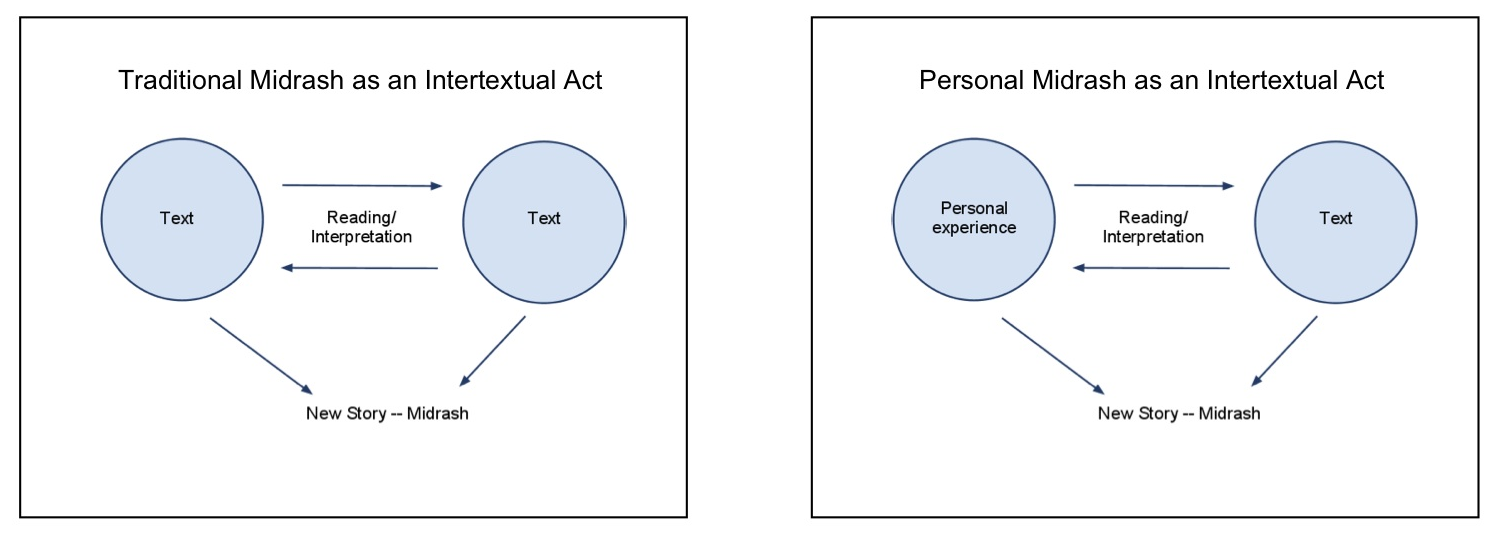


And, so, there is a fourth step to do this work of bringing in God, Torah and Israel.

4) Dialogue with our sources of Wisdom and Holiness. Sometimes I call this step, Holy Writ, but I am avoiding that terminology here because I want to make clear that this stage is not limited to ancient sources like the Bible -- it doesn't even have to be religious sources. It can be any source of wisdom or meaning for us, including poems or motion pictures (movies -- especially ones by deep-thinking, if not so religious, Jews like Woody Allen or the Coen brothers -- are particularly important for me here). [PS. If you haven't gone to see the Coen's A serious man, don't wait a minute longer!]
But -- not surprisingly in a group of Jewish chaplains, many of whom were rabbis -- most of the sources in this group were ones from Jewish Holy texts. One person saw a malach -- an angel -- with a shofar, in effect blowing the person upward. Another person thought of the death of Moshe (Moses), with a kiss from God.

Another had an association that made me see the encounter from a totally different perspective -- he thought of the dramatic reunification of the two deeply estranged brothers, Jacob and Esau, as adults and how they made peace in a moment that had so much potential for violence (and how they seem to have never met, again). This raised the possibility for me that there may have been unseen forces and history keeping the two residents apart before the magical moment of unification the person telling the story witnessed, adding added drama to what she saw.

I got a wonderful surprise from another association. There was a man in the room who had been silent through the whole workshop, and his silence made me wonder if he was somehow disapproving of what we were doing. But then he offered this beautiful association from the daily liturgy (from Talmud Shabbat 127): "These are the things for which a person not only enjoys their fruits in this world, but also their principal -- hakeren kayemet, in Hebrew -- in the world to come: honoring parents, practicing deeds of loving kindness (gemilut hasidim) . . . visiting the sick, making marriages possible (haknesat kalah), and accompanying the dead. . . "

The final one is generally understood as attending funerals, but this person's midrash was to extend it to the moment in this story -- to being with a person as they were dying!

********************

I think this final association is especially worth of the lablel, midrash, as it is, in effect, a new story (see new story's place on the diagram above). My good friend, Rabbi Benjamin Katz reminded me that my diagram promised the creation of something new -- a midrash at the end. I'm still working to clarify how we can best do that!

********************

5) Meaning and action. This is where we try to pull the insights we have come found together. We ask ourselves, have we learned something new? Have we taught ourselves (or others) something new about how to be better caregivers? Better people? Better Jews?

There are so many ways this kind of work can be helpful. At the beginning here, I suggested that this is a process of "working our midrashic muscle," of strengthening our spiritual imagination to make us more sensitive to seeing the Holy in the world and to help others also come to a greater awareness.

Those "others" can be other chaplains, as they were in my workshop. Or they could be patients or congregants. This work can be healing (one participant suggested it could be an important part of self-care for chaplains in danger of forgetting how important their work is amid its many stresses -- I agree!).

********************

One participant said the workship reminded her of Rabbi Dayle Friedman's "PaRDeS" method (which you can find in the book, Jewish Pastoral Care). But she drashed it a bit of switching things around into a PaRSaD method:


  • 1) Peshat (plain meaning): the first step in my process -- the retelling of the story with the focus on the plain concretes (of things like touch and smell).


  • 2) Remez ("hint"): the feelings.


  • 3) Sod ("secret): the images.


  • 4) Drash: the association with Holy text, and the new meanings -- and midrash! -- we make out of it.

[Or at least that's how I best remember what she said. I hope I got it right! (I'm not sure who it was? Ruth Smith? If it was you, let me know!]

********************

Rabbi Katz shared wth me that many in theatre have worked on this facilitator's work in step 1 of asking people questions to help them focus on the concretes of their experience. Minna has often suggested that it might be helpful for us both to get some acting training together. Maybe we will!